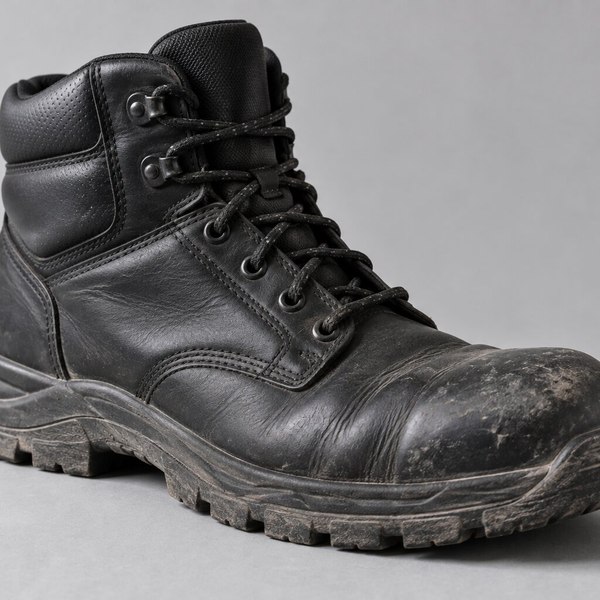
Almost every safety boot sold in the UAE carries a code like S1P SRC stamped on the tongue or inside the shaft. Buyers routinely read these as a quality ranking, assuming S3 must be better than S1P because the number is higher. It is not a ranking. It is a specification, and picking a higher number than the job needs usually means paying more for a heavier boot that your team will be less willing to wear.
The base requirement: EN ISO 20345
All safety footwear sold into the UAE market is normally certified to EN ISO 20345. The standard's one non-negotiable requirement is a toe cap that withstands a 200 joule impact and 15 kN compression. Anything without that is a work shoe, not a safety shoe, and falls under a different standard (EN ISO 20347).
Everything after the base is an add-on, and the letter and number codes tell you which add-ons are present.
What each code covers
| Code | What it adds |
|---|---|
| SB | Base level. 200J toe cap only. |
| S1 | Toe cap + closed heel, antistatic, fuel-oil resistant outsole, energy absorption at the heel. |
| S1P | Everything in S1 plus a puncture-resistant midsole. |
| S2 | Everything in S1 plus water penetration resistance in the upper. |
| S3 | Everything in S2 plus a puncture-resistant midsole and a cleated outsole. |
| S4 / S5 | Moulded polymer boots (PVC or rubber). S5 adds puncture resistance and cleats. |
The P is the part most people miss. It means a puncture-resistant midsole rated to withstand 1100 newtons — protection against a nail or rebar tie going up through the sole. On a construction site where offcuts and fixings are on the ground, that matters enormously. In a clean warehouse aisle, it protects against a hazard that is not present.
Steel or composite?
Both toe caps meet the same 200J requirement, so neither is safer. The differences are practical.
- Steel is thinner for the same protection, so the toe box is less bulky. It conducts heat and cold, and it sets off metal detectors.
- Composite is lighter and does not conduct temperature, which is a real comfort advantage in Gulf summer conditions. It is bulkier at the toe and generally costs more.
The same choice applies to the midsole. Steel plates are proven and cheap; Kevlar and textile plates are lighter, more flexible and cover more of the sole area, because a steel plate has to stop short of the flex point while a textile one does not.
SRA, SRB, SRC — the slip codes
This is the code that matters most in practice and gets the least attention. Slips are among the most common workplace injuries, and the slip rating is tested on specific surfaces:
- SRA — tested on ceramic tile with a dilute soap solution
- SRB — tested on smooth steel with glycerol
- SRC — passes both SRA and SRB tests
If your people work on polished concrete, tiled lobbies, wet wash-down areas or steel walkways, SRC is the rating to insist on. It is frequently absent from budget footwear, and its absence is rarely obvious at the point of purchase because attention goes to the S-number instead.
Choosing for the UAE specifically
Heat changes the calculation. A boot that performs well in a European winter is often the wrong specification here, for reasons that have nothing to do with protection ratings.
| Environment | Sensible specification |
|---|---|
| Construction site, outdoor, uneven ground | S3 — water resistance and cleats earn their place |
| Warehouse, distribution, indoor level floor | S1P SRC — lighter, cooler, same puncture protection |
| Facilities and building maintenance | S1P SRC, composite toe for plant rooms and electrical work |
| Wet processing, food, wash-down areas | S4 or S5 moulded boot |
| Light industrial, workshop, inspection | S1 or S1P, sports-style upper for comfort |
The three mistakes we see most often
1. Over-specifying S3 for indoor work. S3 adds water resistance and a cleated outsole. Inside a dry warehouse both are dead weight, and the boot is hotter and heavier for no protective gain. S1P with an SRC sole protects against the hazards that are actually present.
2. Ignoring the slip rating entirely. Buyers compare S-numbers and price and never look for SRA, SRB or SRC. On smooth indoor floors the slip rating prevents more injuries than the toe cap does.
3. Buying one specification for the whole company. A site team, a warehouse team and a maintenance team face different hazards. One blanket order is simple to place but leaves some people over-equipped and uncomfortable, and others under-protected.
Practical points before you order
Sizing runs differently between manufacturers, and a size 42 in one brand is not a size 42 in another. For any order above a handful of pairs it is worth getting sample pairs before committing, particularly if the team will wear them for full shifts.
Ask for the certification documentation. Every compliant boot has a CE marking and a declaration of conformity naming the notified body that tested it, and any supplier should provide that on request. If a supplier cannot produce it, treat the marking on the boot as unverified.
Footwear requirements differ sharply by sector. We set out what each typically specifies for construction sites and for warehouse and logistics operations, where slip resistance and toe protection are weighted differently.
Ready to specify? Browse our safety footwear range and request a quote with the grade you need.